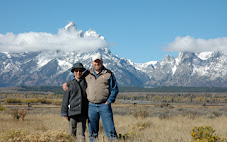
Debi from Niche-Associates called me on Friday, October 23, and asked me to come to work for them. I'll write another blog on this later. I met with Debi and Dennis on Monday, October 26, and agreed to start working on Monday, November 2. I went home and said to Chieko, "Let's go somewhere." She said, "Seattle."
Chieko didn't want to go until Thursday morning, because we had promised to tend Sara's kids Wednesday, on her birthday, but I thought she wouldn't mind too much if we skipped out on that. Sara can blame me.
We left Tuesday morning first thing and came back Sunday night.

The Seattle Temple was right behind the Embassy Suites, where we stayed in Bellevue.

I can't go to Seattle without stopping at the Salmon Cooker for a smoked salmon sandwich on sourdough bread with potato wedges, cole slaw, and clam chowder.

And, of course, we had to visit Pike's Market. I don't remember whether Chieko bought anything, but I bought a picture of some tugboats in the fog.

There's one hot chili pepper.

I'm sure these girls bought a bunch of fruit from this guy. I think he has them hypnotized.

Really?

I used to stay at the Embassy Suites in Milpitas whenever I traveled to San Jose. The suites are two big rooms, one bedroom and one living room with a sink, fridge, and microwave. Plus, they include a cook-to-order breakfast. And with all my stays in San Jose, I had enough points for free rooms in Seattle.

On Wednesday we toured the Boeing plant in Everett. The airplane assembly building in the back left is the largest building in the world by volume. It's .7 mile wide by .33 mile long. It has six assembly bays, where they put together 747s, 777s, and the new 787 Dreamliner. We got to watch the assembly, but they wouldn't let us take any pictures inside. If you go to Seattle, this tour is worth the time.

On the day we toured the plant, Boeing announced that it was building its new 787 assembly plant in South Carolina. This is a HUGE loss for Seattle. I'm sure Boeing is still the biggest employer in the Seattle area, even with Microsoft there. This story made front-page headlines the whole time we were in Washington, as everyone blamed the unions, the government, and Boeing, in that order.

This is the copilot of a 727.

On Thursday we drove to Vancouver. Even though Weather Underground said it would rain all week, this was the only day that we really got rain a lot of rain. We took the sea bus across the harbor to North Vancouver to the Lonsdale Quay (Q) Market, kind of a farmer's market, similar to Pike's Market in Seattle, but different. The sea bus goes right to the market.

In case you didn't know, I am a big fan of anything related to tug boats. This stems from a time I was especially stressed at work. I happened to be in Seattle, and while sitting on the pier I noticed how peaceful the tugboats looked in Puget Sound. I decided I wanted to become a tugboat pilot. However, the closest I've gotten so far is to mostly build a radio-controlled tugboat (it isn't finished) and ride on the real tugboat (Shelley Foss) the model is based on in the Seattle Sea Fair tugboat races in 1994.

At the Q Market we ate a really yummy Italian Wedding homemade soup. I have to confess: my plan was to take pictures of all our meals, since eating seemed to become a big part of this trip. But almost every time I was so hungry, and the food was so good, that I forgot to take a picture until the meal was half gone.

The people at this little store in the market are making giant candy canes from scratch. The sugar is boiling in a big copper kettle in the corner, and we watched them pull and twist the cooling sugar mass into a long rope that they cut and formed into canes. The people were very friendly and invited me to come behind the table to take this picture. Of course I also bought a $7 candy cane, too. (They also had peppermint candy canes, but I like the tooty fruity colors.)

Back in Vancouver near the sea bus terminal is Gastown. This is where Vancouver began in 1867, the same year Canada become a nation. Today the cobblestone streets are lined with touristy and trendy shops. This steam-driven clock was built in 1977, based on an 1875 design. It uses the same steam that heats the buildings in the area. It's supposed to play music, but we didn't hear any.

There are two cities in North America with ramen restaurants that I would travel to just to eat ramen. One is San Mateo, California. The restaurant is called Santa. The other is Vancouver, British Columbia. The restaurant there is called Sapporo Ramen. I looked forward to the Sapporo ramen from the moment Chieko suggested Seattle as our destination on Monday. Unfortunately, the restaurant is no longer. How disappointing. By the time we discovered it was gone we had driven all over Vancouver in the rain and traffic with my Garmin GPS on the fritz, and we were ready to eat any ramen or anything else anywhere. Chieko asked someone in another Japanese restaurant if there were any ramen shops around. The girl directed us to Benkei Ramen. Wow. This is my new favorite, better than San Mateo's, I think.

Where in the world is Costco? Take this elevator down from street level to the next street level below. Chieko bought a down-filled Ralph Lauren parka here. Then we walked back to the Hampton Inn in the rain.

On Friday we took a BC Ferry from Tsawwassen to Swartz Bay on Vancouver Island.

We were lucky to get on a ferry two hours earlier than the one we had reservations for and landed in Sidney just before the Olympic torch came through town. We found a place to park and lined up on the street with the other 10,000 people. This woman, Bridgette, was waiting near us for her turn to run with the torch. While waiting, she let me hold the torch to see how heavy it was.

Finally, the lit torch showed up and Bridgette was on her way.

We love the winter Olympics and felt lucky to be here, since we missed the torch festivities for the Salt Lake Olympics in 2002, because we were living in California, although we did come to Salt Lake to see some of the events. The Vancouver Olympics start in February. In the meantime, the torch will travel all across Canada, to within an hour of 90% of Canadians, including those in the world's northernmost villages.

Another disappointment was the fish and chips. I was so looking forward to fish and chips on the harbor next to the houseboats. The consierge at the Marriott said it was closed for the season. How sad. He suggested Red Fish Blue Fish right on the Inner Harbor as an alternate choice. You can see Red Fish Blue Fish in the background in this picture. It's the shipping container.

This is my new favorite fish and chips by far. I was on a quest for a while to find the best fish and chips in North America, along with my quest to find the best BBQ restaurants. For fish and chips, this is number one. The other place was good, but I was glad it was closed.

Look how thick and juicy this halibut is, and how thin they make the crispy batter. And every seat at this restaurant has a beautiful harbor view.

At night we walked to the prefectural legislature building, where the Olympic torch was wrapping up its day's run. There was a lot of singing and dancing and a drizzle of a rain. Coke is a major sponsor of these Olympics, and I got a coke bottle that glows (free after standing in line), as well as two little, 250ml, aluminum coke bottles (filled, $2 at 7-Eleven).

On Saturday we took the Washington State ferry from Swartz Bay to Anecortes. We had to go through U.S. Customs on the Canada side and again on the Washington side. Go figure. This is a three-hour trip through the most beautiful islands in North America. Another unexpected sunny day.

At night we ate dinner at I Love Sushi in Bellevue. This is not the sushi boat I Love Sushi that is in California. This place is really good. This sushi bento is by far the best I've ever had. I shouldn't admit it, but we ate here twice on this trip, and I had the same thing both times. Except on the first visit we also had smelt sushi that was really good but that was not on the menu when we went back.

If you cross the Aurora Bridge (officially the George Washington Memorial Bridge) over Lake Union, watch out for this troll.
The battery in my camera died, so the rest of our trip is on this short video taken with Chieko's new iPod Nano. Yes, we did eat at the Salmon Smoker again, too. And we made a last stroll through Pike's Market.
 I took I-15 to Cove Fort. Did you know there are a couple of test sections between Nephi and Filmore where the speed limit is 80? And I saw a guy being pulled over on the northbound side. I guess 80 just wasn't fast enough. (Sorry for the poor picture; it's tough to get a good picture while driving at 80 mph.)
 From Cove Fort I took the dirt Black Rock Road to Highway 257. Black Rock Road crosses these tracks, which parallel 257.
 The new Milford windmill farm (biggest windmill farm in Utah) is just north of the Black Rock Road and east of Hwy 257.
  Newhouse is spread out over a wide area, with a train line running along the east side--the tracks are gone, but the rail bed now provides the easiest way to drive in here, which I discovered after I'd taken the hard way. Part of the rail bed still has ties mostly buried in the dirt.
  This house had a great view of the desert valley and the Wah Wah Mountains.
  There's not much left of this stone and stucco house. Two prairie dogs were living in the piece of wall that was the house next door.
  Brick walls stand lonely here and there.
  One the tracks side of town were smelters and other mining structures I couldn't identify.
  Mostly they've all been driven to ruin.
  I don't know what this is, but I thought it looked cool. Actually, I know what it is: a bottle bottom, a heavy iron ring, and a piece of wood. What I don't know is why.
  To take this picture I scraped a rabbit's nest out of this pipe. He'll have to rebuild, but his house is still in better shape than the human houses around here.
  I didn't find the cemetery--I forgot to look for it--but I thought this looked like a fitting marker for the town's industry.
  I also went back to part of Frisco, where I visited a couple weeks ago. This is the inside of a charcoal kiln at Frisco.
  The structures at Frisco are in better shape than the ones at Newhouse. Many of the Newhouse buildings were moved to Milford, including the dance hall floor. The train station was moved to a nearby ranch, where it's supposedly still in use.
  Frisco is in two locations. This is part of the "downtown," which is just below the charcoal kilns. The part with the best surviving structures is below the mines and behind "No Trespassing" signs.
  Last week I spent $1,500 to replace the antilock-brake controller and a wheel bearing with speed sensor. Add a little mud, a visit to a couple of ghost towns, and 500 miles on a Saturday, and the Tahoe is happy now.